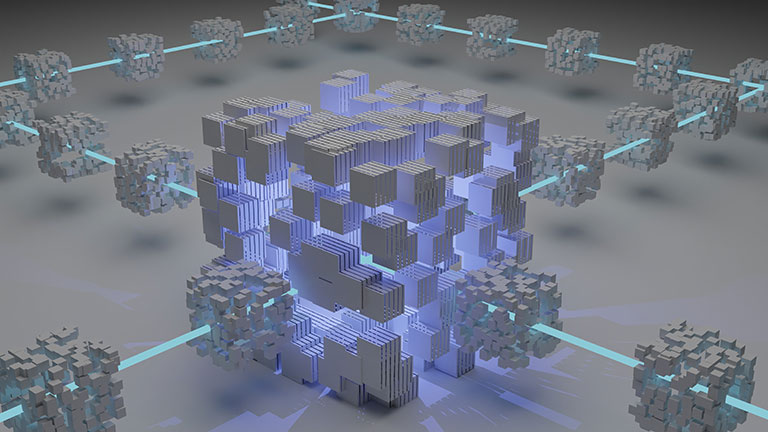
Blockchain is Coming to Real Estate, But What is It?
By creiland - Blogs Posted in Blogs On February 14, 2022Blockchain is a business buzz word today, but the technology itself is here to stay. It has applications in countless industries (including commercial real estate!) and it comes with the potential to transform how we work today. With that in mind, we thought we’d explore what blockchain is and then in a second article, next month, its applications to the commercial real estate industry.
Defining the Blockchain
A blockchain is a type of shared database, known as a distributed database. What this means is that the information in the database is being stored and processed by a network of many different computers instead of a single, centralized source.
Blockchain Nodes
Computers involved in the blockchain network, as with any network, are called nodes. Each node has a copy of the entire database that can be used to verify the legitimacy of transactions that take place through the database.
Blockchains are Ledgers
Blockchain databases operate as ledgers. Every change to the ledger has to be confirmed by a majority of nodes (at least 51%). Once a transaction is verified, it’s given a time stamp and linked to other transaction data already in the blockchain. Transactions cannot be reversed or changed unless a majority of nodes verify the change.
In practice, this means that no one can make changes to the ledger without the consent of others. This ensures the legitimacy of verified transactions.
Because everyone who has a copy of the database can view every transaction, there’s also a high level of transparency. Changes cannot be made secretly.
Not all blockchains are used for financial transactions. Ledgers can be used to record all kinds of data.
Transaction “Blocks”
The blockchain gets its name from the way it stores data.
Every time a transaction is verified, that data is put together with other verified transactions and turned into a data “block”. Blocks are just collections of transaction data that are stored together in chronological order.
When a block is filled with data, it’s closed. From there, it gets linked to the existing blocks in the chain to form a complete history of all transactions.
What Makes Blockchain Different?
The decentralized ledger system dramatically changes how people interact with the database.
These are the major differences:
- All changes are certified as legitimate without the need of a third party
- There is no single point of failure for an entire network
- Changes are fully transparent, preventing malicious tampering
- Users can be anonymous while still using the database with full transparency in their actions
Uses for Blockchain Tech
There are many ways to use blockchain databases, beyond cryptocurrencies. Blockchain tech is already being used in many industries today and has other proposed uses that are incredibly diverse. Some existing uses include:
- Confirming financial transactions
- Certifying contracts
- Verifying identification
- Inventory management systems
- Supply chain management systems
- Recordkeeping
Blockchain has also been proposed for use in elections, property deed verification, autonomous car ownership, and more.
Blockchain Myths
There is a lot of misleading information circulating around blockchain tech. Here are some common myths about blockchain that you might have encountered.
- Blockchain is cryptocurrency Although blockchain tech was popularized through its use with cryptocurrencies like Bitcoin, these are actually 2 distinct things. Cryptocurrencies operate on their own blockchains, but blockchain tech can be used to do many things unrelated to cryptocurrency.
- All information on a blockchain is public Blockchains don’t display the private information of the people using them. The only information that’s publicly accessible is the origin of data and the recipient. This does not include the personal information of anyone involved. It’s also possible for blockchains to be private, only accessible to permitted users.
- Blockchain is 100% secure and unhackable Blockchain is more secure in some ways, but no network is 100% secure. Because blockchain networks are decentralized, they have some unique benefits for transaction security.
- Blockchain is better than traditional databases There are some situations where blockchain databases are superior to traditional databases, but it’s not always the case. Every type of database has its own use cases.
- Blockchain is expensive and slow Bitcoin’s use of the blockchain is widely known for its inefficiency, but it’s also an early adoption of the technology. Modern blockchains are faster and much more efficient.
- Blockchain is cloud-based Although there are similarities between blockchains and cloud databases, blockchain tech is not cloud-based.
Conclusion
Blockchain tech has a lot of fantastic applications across different industries today and it will reach more in the future. By understanding more about what blockchain is and how it works, you can be better prepared to take the right opportunities as they come. Be sure to watch for our next article on blockchain applications to commercial real estate.
Leave a Reply
Your email address will not be published. Required fields are marked*


 The trademarks REALTOR®, REALTORS®, and the REALTOR® logo are controlled by The Canadian Real Estate Association (CREA) and identify real estate professionals who are members of CREA.
 The trademarks MLS®, Multiple Listing Service® and the associated logos are owned by The Canadian Real Estate Association (CREA) and identify the quality of services provided by real estate professionals who are members of CREA.